

Share On:

Most investors worry about volatility: the daily swings that trigger anxiety and celebration. But volatility isn't the real problem.
The real portfolio damage comes from extended drawdowns. These are prolonged declines stretching across months or years, eating away at capital while the clock keeps ticking.
Managing drawdown duration is one of those structural problems most strategies ignore.
In this article, we will show you why drawdown duration poses a greater threat than short-term volatility and how a rules-based defensive approach creates protection that behavioral coaching alone cannot provide.
The Mathematics of Drawdown Duration
Here's what most investors don't realize: a 50% portfolio loss requires a 100% return just to break even. A 30% decline requires a 42.9% gain to recover.
Duration Compounds the Damage
Research on 6,500 stocks from 1985 to 2024 reveals something striking: the median drawdown was 85% and took 2.5 years from peak to trough. More than half never recovered to prior highs.
Every moment your portfolio spends underwater is lost growth opportunity. For investors with finite time horizons (particularly those in or approaching retirement), this duration risk is catastrophic.
Key Point: The asymmetric math of recovery means drawdown duration, not daily volatility, poses the greatest threat to long-term portfolio outcomes.
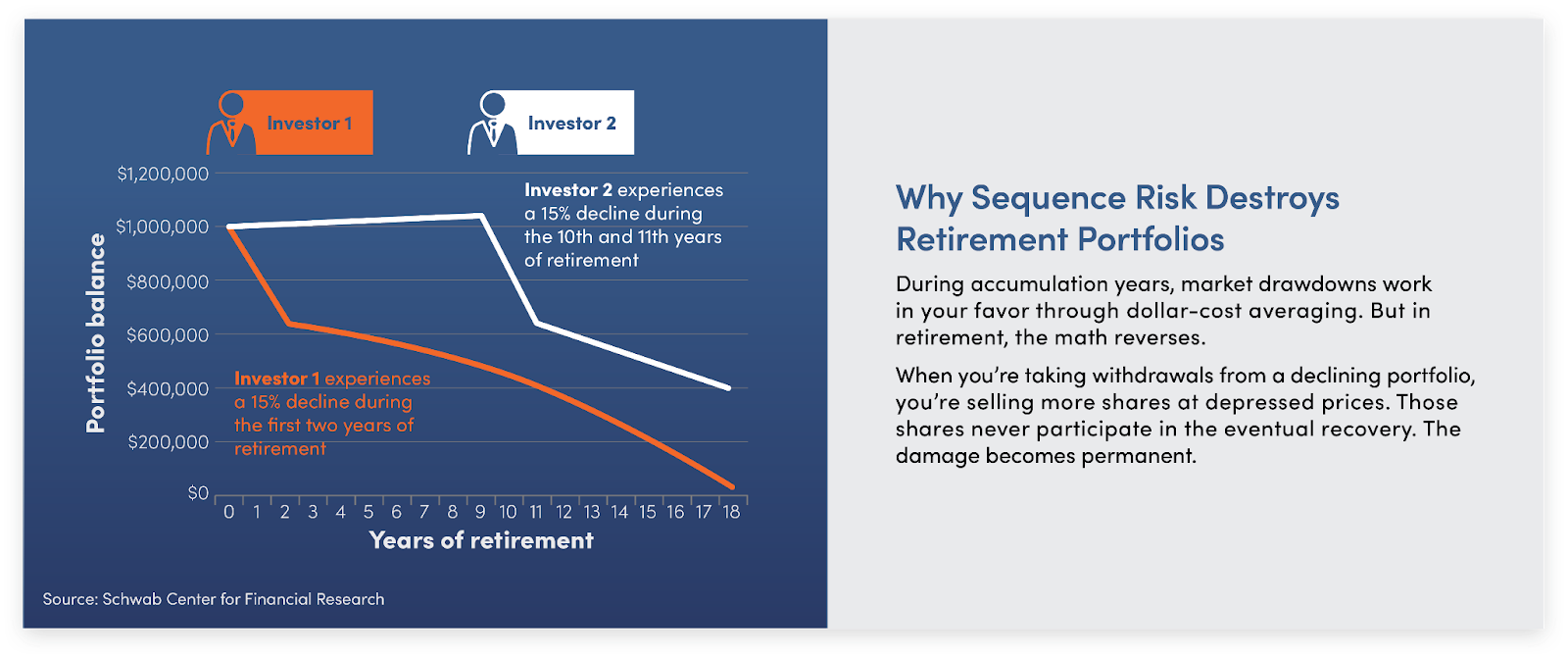
This is “sequence of returns risk” and research shows that the compounded return in your first 10 years of retirement can explain 77% of your final retirement outcome.
Key Point: Sequence of returns risk makes the first 10 years of retirement the most critical, explaining 77% of final portfolio outcomes.
The 2008 Crisis Proves the Point
The 2007-2009 Global Financial Crisis dropped the S&P 500 by 57% and took 5.5 years to recover. The 2000-2002 Dot-Com Bust required seven years to recover from a 49% decline.
For retirees taking distributions during those extended periods, the combination of declining values and forced withdrawals created permanent capital impairment. No amount of eventual market recovery could fix the structural damage.
Key Point: The GFC and Dot-Com Bust demonstrate that extended recovery timelines, not peak losses alone, cause permanent capital impairment for retirees.
The Concentration Paradox
Traditional thinking says diversification reduces risk. But diversification gives you the average: both outperformers and underperformers.
ADPV takes a different approach. It concentrates on 25 U.S. stocks, selected from the largest 1,000 companies, and re-ranks them weekly based on momentum characteristics.
Research shows fund managers' best ideas outperform the rest of their portfolio by 1.6% to 2.6% per quarter. Concentrated managers outperformed diversified peers by roughly 4% per year, specifically from their biggest bets.
Fishing in the Right Spots
While not every selection wins, the strategy consistently identifies stocks on the right side of the performance distribution curve: owning A and B students, not dragging down returns with D and F students.
Key Point: Concentrated portfolios of highest-conviction holdings have historically outperformed diversified peers by roughly 4% per year.
The Momentum Trap in Bear Markets
Traditional momentum strategies have a structural flaw: they stay invested throughout market cycles, including bear markets where momentum works in a negative direction.
Research on momentum factor performance reveals crashes occur during reversals from bear markets, when portfolios display negative market beta. Traditional momentum ETFs remaining fully invested suffer catastrophic losses during these reversals.
Key Point: Traditional momentum strategies have no mechanism to avoid bear market reversals, where the most catastrophic momentum crashes occur.
The Defensive Trigger That Changes Everything
ADPV solves this structural problem with a rules-based defensive trigger.
The strategy measures the 5-day and 200-day moving averages of the 500 largest U.S. stocks. When the 5-day falls below the 200-day on a Friday, the strategy shifts to cash and T-bills for the following week.
This isn't market timing. It's systematic risk management based on supply and demand signals. When short-term trends fall below long-term trends, the system recognizes potential weakness and moves to safety.
Key Point: A rules-based defensive trigger using moving average crossovers provides systematic risk management without discretionary market timing.
Behavioral Infrastructure vs. Behavioral Coaching
Research confirms unmanaged drawdowns trigger panic and ill-timed exits at market bottoms. Big losses prompt permanently conservative allocations that may not meet longer-term wealth goals.
The Garage Analogy
ADPV's rules-based approach creates behavioral infrastructure. Instead of coaching clients to stay invested through storms, you explain the strategy is parking the car during snowy roads or landing the plane instead of flying through turbulence.
When the 5-day average is above the 200-day, the strategy participates. When it falls below, it moves defensive. The decision is systematic, transparent, and easy to communicate, solving the advisor's client retention problem that education alone cannot address.
Key Point: Rules-based defensive positioning creates behavioral infrastructure that solves the client retention problem behavioral coaching alone cannot address.

Capital Preservation as Offensive Strategy
By avoiding the deepest phases of extended bear markets, you preserve capital for redeployment when trends improve.
An investor who avoided selling during an 18% first-year decline ended a 20-year period with roughly their starting portfolio value. An investor who sold during the decline? Complete portfolio depletion by year 17. Same average returns, completely different outcomes.
Key Point: Capital preservation during drawdowns is an offensive strategy because it preserves purchasing power for redeployment when trends improve.
Implementation Framework for Advisors
Advisors use ADPV in several ways within portfolio architecture:
-
- As a large-cap replacement: Some advisors allocate a portion of their S&P 500 exposure to ADPV, gaining active risk management while maintaining large-cap equity exposure.
-
- As a stock selection sleeve: ADPV serves as a dedicated component focused on momentum-driven stock selection within a broader portfolio structure.
-
- As differentiated momentum exposure: Unlike traditional momentum products that remain fully invested, ADPV provides momentum exposure with systematic defensive capabilities.
Key Point: ADPV can serve as a large-cap replacement, stock selection sleeve, or differentiated momentum exposure within existing portfolio architecture.
Setting Realistic Expectations
ADPV underperforms when momentum factors weaken, which can happen for weeks to months. During initial correction phases before the 5-day crosses below the 200-day, the strategy can exhibit high beta characteristics downward.
Advisors need to communicate these dynamics clearly. The goal isn't perfection. It's risk-managed participation across full market cycles.
Key Point: ADPV is not designed for perfection; it is designed for risk-managed participation across full market cycles, and advisors should set expectations accordingly.
Why This Matters Now
Markets don't move in straight lines. Building trust architecture means creating systems that work across different market environments without requiring perfect timing or emotional discipline during crises.
The Trust Architecture Advantage
ADPV doesn't claim to avoid every selloff or promise perfect timing. What it provides is systematic, transparent risk management based on supply and demand signals: a rules-based framework removing emotional decision-making.
Key Point: Trust architecture means building systems that work across market environments without requiring perfect timing or emotional discipline.
Final Thoughts
Extended drawdowns destroy more wealth than short-term volatility ever will. For investors in or approaching retirement, the combination of drawdown depth and duration creates sequence risk that can permanently impair portfolios.
ADPV's concentrated approach with weekly reconstitution and rules-based defensive positioning addresses this structural problem, seeking to preserve capital during the phases that matter most.
This is what building for durability looks like: not the flashiest strategy, but the one that solves problems investors can't afford to ignore.
Want to learn more about how ADPV might fit within your portfolio architecture? Schedule a consultation to discuss how this approach aligns with your specific investment objectives and risk management needs.
Key Point: Extended drawdowns, not short-term volatility, are the structural threat that rules-based defensive positioning is designed to address.
Key Takeaways
- - Drawdown duration destroys more wealth than daily volatility
- - Sequence risk makes the first 10 retirement years the most critical
- - Rules-based defensive triggers provide systematic capital preservation
- - Concentrated momentum portfolios outperform broad diversification
- - Behavioral infrastructure solves problems coaching alone cannot


Comments